History
Chateau d’Issan is one of the oldest wine-producing properties in the Medoc as well as in all of Bordeaux. In 1152, the wine produced by what we know of as Chateau d’Issan today was served for the royal wedding between Eleanor of Aquitaine and King Henri II. At the time, the estate was known as Chateau Lamothe Cantenac.
Jumping ahead a few centuries to the 17th century, the estate became the official possession of the d’Essenault family.
The name, d’Issan is based on an early phonetic spelling of d’Essenault. d’Essenualt, a member of Parliament and a knight began an extensive program of rebuilding, renovating, and redesigning the estate. Eventually, he built a new castle next to the vineyard and continued his construction projects until the French Revolution.
Chateau d’Issan The Modern Age
Skipping ahead several centuries to the modern era for Chateau d’Issan, the vineyard was purchased shortly after the conclusion of World War 2 in 1945 by the well-known Cruse family, who were successful negociants and vineyard owners. When they purchased the vineyard, everything was in poor shape.
The cellars were dilapidated and needed complete rebuilding. In fact, they were in such bad shape, their 1945 wine had to be vinified at Rauzan Segla. The harvest was indeed tiny, as perhaps less than 5 hectares of land was still cultivated with vines. The Cruse family continues to own and manage the Medoc estate today.
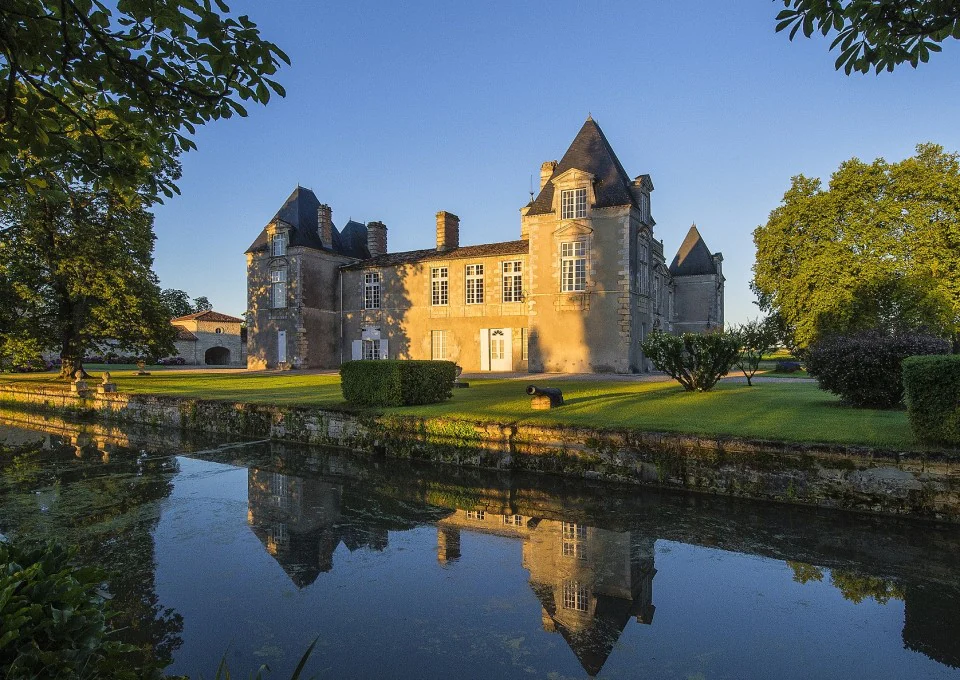
Chateau d’Issan remains one of the most picturesque estates in the area. With its moats, drawbridge and courtyard, Chateau d’Issan looks like a beautiful castle out of a fairy tale. It is well worth your time to visit. Chateau d’Issan truly is one of the most beautiful properties in all of Bordeaux.
The current high level of quality at Chateau d’Issan can be traced back to 1998. That is the year Emmanuel Cruse took over the job of managing the Left Bank property. Since 1998, Emmanuel Cruse has slowly but surely turned Chateau d’Issan into one of the top estates in the Margaux appellation.
In February 2013, Chateau d’Issan sold a 50% stake in the historic Medoc property to Jacky Lorenzetti. Jacky Lorenzetti has been working with Emmanuel Cruse on his other Left Bank Bordeaux chateaux including; Chateau Lilian Ladouys and Chateau Lafon in St. Estephe and Chateau Pedesclaux in Pauillac.
Emmanuel Cruse modernized Chateau d’Issan with the addition of sorting tables and a new pneumatic press, along with building a new reception area to receive the grapes. The portion of new French oak barrels used to age the wine has also increased to an average of 50%. Most importantly, the greater selection is now utilized with the fruit with more of the harvest going into the second wine of Chateau d’Issan.
Vineyards, Terroir, Grapes, Winemaking
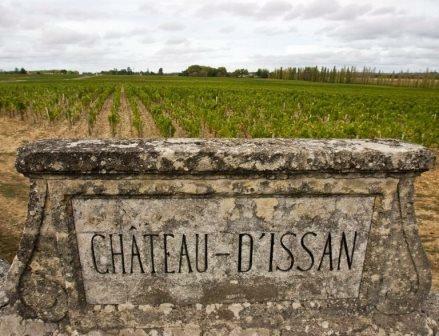
The 52-hectare vineyard of Chateau d’Issan is planted to 65% Cabernet Sauvignon, 30% Merlot, 2% Cabernet Franc, 2% Petit Verdot and 1% Malbec. This represents a shift in the vineyard plantings since the 1990s, as today, there is less Cabernet Sauvignon and more Merlot in the vineyard.
And more interestingly, as you can see, now you find all 5 Bordeaux varietals in the vineyard with small amounts of old vine Petit Verdot, planted in 1948, Cabernet Franc, planted in 1958, and Malbec as well.
The increase in the size of the vineyard is due to a combination of recent purchases and a ruling in 2007 by the INAO that allowed Chateau d’Issan to add 10 hectares of vines that were previously classed as part of the Haut-Medoc appellation. Following the decision to expand the Margaux appellation, those vines were re-classified as part of Margaux.
The vineyard has a terroir of gravel with clay and limestone soils on gentle, rolling, slopes. The vineyards of Chateau d’Issan are planted to a vine density of 9,000 vines per hectare with vines that are on average 35 years of age.
They have old vines as well, some of which are more than 70 years of age. More importantly, the vineyard is situated only 800 meters from the Gironde estuary providing moisture in dry years and a buffer from high heat and frost.
Their best terroir is next to the chateau in the enclos which surrounds much of the estate. While today Chateau d’Issan is dominated by Cabernet Sauvignon, which was not the most important grape at the time of the 1855 Classification. In fact, in those days, Chateau d’Issan was planted to 100% Tarney Coulant, a grape that is now almost extinct in Bordeaux today.
The entire property takes up 127 hectares, with 52 hectares under vine. Here’s a secret for you. For the 2015 vintage only, Chateau d’Issan made 1 special barrel of wine that came from vines planted in the exact borders of d’Issan at the time of the 1855 Classification of the Medoc!

🏅James Suckling 96pts
Aromas of blackberry, plum, cocoa, iodine, clove and graphite. It’s medium-to full-bodied with firm, silky tannins. Tightly wound and mineral at the moment, with dusty gravel and graphite notes, yet with focus and precision. Such balance and harmony for the vintage.
🏅Robert Parker 94-96 pts
The 2018 D'Issan is composed of 60% Cabernet Sauvignon and 40% Merlot, aging in 50% new and 50% second year barrels for an estimated 18 months. With 13.97% alcohol and a deep garnet-purple color, it features baked berries, warm cherries and cassis with spice box and fragrant earth plus tea hints. Medium to full-bodied, it has a great core of muscular fruit with firm, fine-grained tannins, with nice freshness, finishing layered with mineral notions.
🏅Decanter 95pts
Well-balanced, fleshed out by redcurrant, raspberry and black cherry fruits. There is tannic build-up, gently layering but adding up to quite the wall at this stage, suggesting a long life ahead, and beautifully judged cigar smoke edging through the finish. Good stuff from Issan, and a wine I have tasted both at en primeur and during ageing in barrel. 50% new oak.
🏅Jancis Robinson 17/20
Deep core and cherry rim, not quite as black-hearted as most Bordeaux 2018s. Intense ripe cassis that is pure Cabernet. Nicely savoury too. Chewy and quite oaky on the palate, the tannins thickened by the oak but very smooth. Dense and still fresh. Very good.
🏅Jeb Dunnuck 95ptsThe top wine, the 2018 Château D'Issan is 60% Cabernet Sauvignon and 40% Merlot that spent 18 months in 50% new French oak. It offers a beautiful, singular bouquet of blackcurrants, new leather, smoked tobacco, scorched earth, and camphor. This carries to a medium to full-bodied, seamless Margaux with wonderful tannins, beautifully integrated acidity, and just a flawlessly balanced, elegant, layered style that's going to evolve for 20-25 years. It's one classy 2018 that has loads to love.