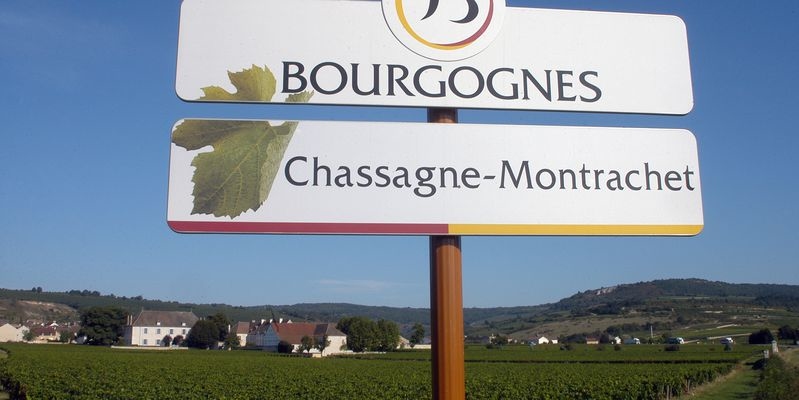
Chassagne-Montrachet is a village in the Côte de Beaune sub-region of Burgundy and a communal appellation, created in 1937. The designation covers both red wines, made from Pinot Noir, and whites made from Chardonnay.
The output ratio of red and white wines is roughly 35:65. White Chassagne-Montrachet wine is historically more renowned. This led to a marked increase in white wine production during the latter years of the 20th Century. Much recent planting has, however, been on flatter areas, with more fertile soils. Lighter wines are generally made from these sites.
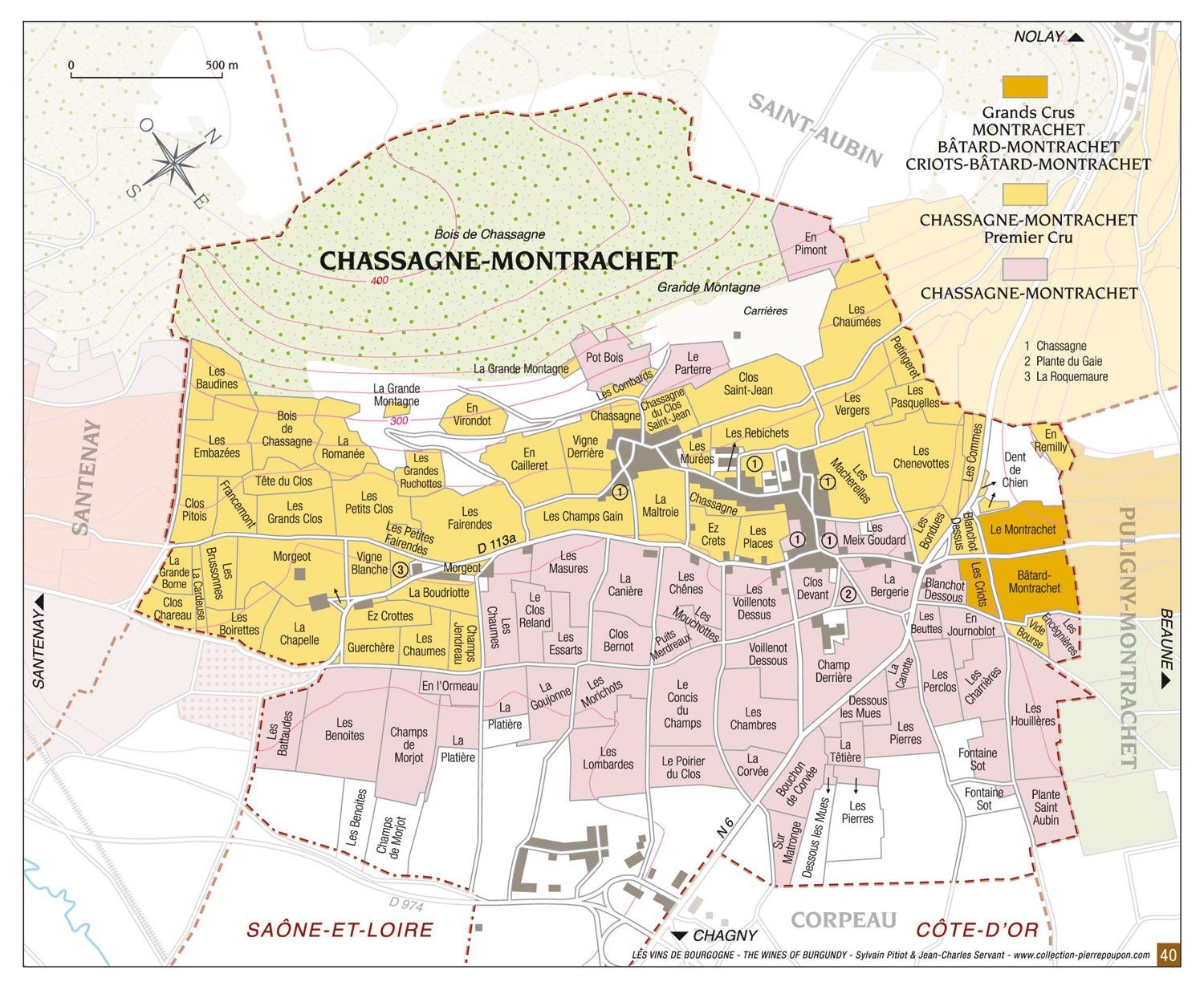
The village-level appellation covers around 300 hectares (740 acres). Most of this lies below the road between Puligny and Santenay. However The three Grand Crus lie within the smaller section above the road to the northeast. The Le Montrachet and Bâtard-Montrachet Grand Crus straddle the border with Puligny-Montrachet. 3ha of the former and 5.62ha of the latter (7.4 and 13.9 acres) lie within Chassagne-Montrachet. Criots-Bâtard-Montrachet is the most southerly of Burgundy's Grand Cru vineyards. This tiny plot (1.57ha, 3.89 acres) adjoins Bâtard to the southwest and lies completely within the commune.
Chassagne-Montrachet also boasts a large number of Premier Crus; 55. These cover 149ha (368 acres), of which 117ha (79 acres) are planted to Chardonnay. They flow unbroken from its southern border with Santenay to Puligny-Montrachet. Some of the most prominent Premier Cru vineyards include Vergers, En Remilly, La Maltroie and Morgeot. The latter covers 58ha (142 acres) in the southeast, and is the largest Premier Cru here. However it is divided into over 20 lieux-dits the title of which may be used by producers.
The soils around the commune have a high content of limestone. This is particularly so on the slopes of the Côte d'Or, the 45 kilometer (27 mile) limestone escarpment running from Dijon to Santenay. There is a distinct difference, however, between the vineyard sites to the south of Chassagne-Montrachet village and those to the north. To the south, they have a higher concentration of limestone marl and red gravel – soils which suit Pinot Noir better. To the north, the harder marlstone gives way to softer, finer limestone structures; it is here that some of the world's most-respected Chardonnay is produced. Some years ago a group led by Bernard Morey tried to draw up a Chardonnay map of the appellation. The project was intended to match the grape variety with the best soils, but it did not receive enough support to be carried out.
The climate around Chassagne-Montrachet is of continental type, with warm, dry summers and cool, extended winters. Spring arrives earlier here than in Burgundy's northern outposts like Chablis. Nevetheless the commune's viticulturalists must still contend with cold spring mornings and the risk of frost damage to their vines.